Biggest Zowie Ec3-C Buying Mistakes (And How to Avoid Them)
The BenQ Zowie EC series has long been the gold standard for ergonomic competitive gaming mice. When Zowie released the EC3-C, it addressed a specific niche in the market: players who loved the legendary EC shape but found the EC2 too large or the EC1 unwieldy. However, despite its pedigree, the EC3-C is frequently misunderstood by the gaming community. Many enthusiasts and professional aspirants rush into the purchase based on brand reputation alone, only to find that the "small" variant of this classic line doesn't quite fit their needs. Avoiding common buying mistakes requires a deep understanding of hand dimensions, grip styles, and the specific engineering trade-offs Zowie made with the C-series update.
The Evolution of the EC Shape: Understanding the EC3-C
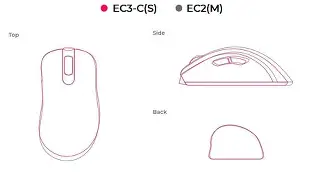
To understand why buyers often make mistakes with the EC3-C, one must first understand its place in the lineage. The Zowie EC series is defined by its asymmetrical, right-handed ergonomic design. It features a high hump on the left side that slopes down toward the right, mimicking the natural resting position of the human hand. For years, the EC1 (Large) and EC2 (Medium) were the only options. The EC3-C was introduced as the "Shorter" version rather than just a "Small" version.
This subtle distinction is the source of many buyer regrets. Unlike some manufacturers who scale every dimension down proportionally to create a small mouse, Zowie specifically shortened the length of the EC3-C while maintaining a relatively significant width and height profile. This creates a unique "stubby" feeling that is vastly different from other small ergonomic mice on the market. It is engineered for maximum maneuverability in the vertical axis, allowing the palm more room to move before hitting the back of the mouse, but this design choice is a double-edged sword for certain grip types.
Mistake #1: Confusing Shorter Length with Overall Smallness
The most frequent error buyers make is assuming that because the EC3-C is the smallest in the EC lineup, it will feel like a tiny mouse similar to a Razer Viper Mini or a Logitech G Pro. In reality, the EC3-C feels surprisingly "full" in the hand. Because Zowie kept the width at the grip point relatively close to the EC2, the mouse handles more like a medium-sized mouse that has had its "tail" docked.
When gamers with very small hands buy the EC3-C expecting a featherweight, dainty peripheral, they are often met with a mouse that still fills the palm. If your goal is a mouse that allows your fingers to wrap entirely around a narrow chassis, the EC3-C might actually feel too bulky. To avoid this, prospective buyers must check their hand width, not just their hand length. If you have narrow hands but long fingers, the EC3-C may feel awkward because the width forces a wider finger spread than you might prefer for a "small" mouse.
Mistake #2: Ignoring the "C-Series" Cable and Weight Updates
Many buyers accustomed to the older "B" version of Zowie mice or the older glossy coatings move to the EC3-C without realizing how much has changed under the hood. The C-series signifies Zowie’s move toward modern standards, including a significantly lighter weight (approximately 70 grams) and a paracord-like cable. However, a common mistake is assuming "lighter is always better."
In the world of tactical shooters like Counter-Strike or Valorant, stability is king. Some players who are used to the 90-gram weight of older EC2 models find the 70-gram EC3-C to be "flighty" or "jittery." While the industry is trending toward ultra-light mice (sub-50 grams), Zowie has intentionally stayed in the 70-gram range to preserve a sense of control. Buyers make a mistake when they buy this mouse thinking it will compete with hole-punched ultra-lights. It is a balanced mouse, and if you are looking for the lightest possible experience, the EC3-C will feel heavy by comparison.
Detailed Product Analysis: The Professional Standard
The Zowie EC3-C utilizes the PixArt 3360 sensor. While some hardware enthusiasts call this an "aged" sensor compared to 3395 or 3399 variants, it remains a flawless performer in real-world scenarios. The implementation in the EC3-C is rock solid, with no spin-outs, no tilt-slam issues, and a very low lift-off distance that is adjustable via button combinations on the bottom.
The build quality is where the EC3-C shines. Unlike many modern mice that creak when squeezed, the EC3-C feels like a solid block of high-grade plastic. Zowie uses a 24-step optical scroll wheel, which is a point of contention for many. It is loud, tactile, and distinctly "notchy." This is perfect for gaming—preventing accidental scrolls when jumping or switching weapons—but it is a poor experience for office work or long web-browsing sessions. Buying this as a "hybrid" work-and-play mouse is a significant mistake.
Discover deals on Electronics — updated daily.
Shop Amazon →Physical Specifications and Comparison
To help visualize the dimensions and how it compares to its siblings, consider the following data. This illustrates why the EC3-C is often miscategorized by size alone.
| Feature | Zowie EC1-C | Zowie EC2-C | Zowie EC3-C |
|---|---|---|---|
| Length | 130 mm | 123 mm | 119 mm |
| Width (Back) | 69 mm | 65 mm | 66 mm |
| Height (Hump) | 42 mm | 42 mm | 41 mm |
| Weight (Approx) | 80g | 73g | 70g |
| Intended Hand Size | Large/X-Large | Medium/Large | Small/Medium |
Notice that while the length drops significantly from the EC2 to the EC3 (123mm down to 119mm), the width at the back actually increases slightly, and the height remains almost identical. This confirms that the EC3-C is a short but stout mouse, not a miniaturized version of the EC2.
Mistake #3: Overlooking Grip Style Compatibility
Grip style is perhaps the most subjective yet critical factor in mouse selection. The EC3-C is specifically tailored for Palm Grip and Claw Grip users. Because the back of the mouse is shorter, it allows claw grippers to pull the mouse deeper into their palm for vertical adjustments—a maneuver that is often hampered by the longer "tails" of the EC2 or EC1.
A major mistake is attempted Fingertip Grip on the EC3-C. While it is short enough to theoretically allow it, the ergonomic slant and the height of the hump make it difficult to maintain a consistent fingertip anchor. The mouse wants to be held; it wants skin contact. If you prefer a "floaty" fingertip style where only your pads touch the mouse, the EC3-C’s asymmetrical curves will likely cause your hand to cramp as you try to compensate for the right-side slope.
Pros and Cons of the Zowie EC3-C
- Pro: Superb Ergonomics - The shape is refined through years of professional feedback, providing one of the most comfortable fits for right-handed users.
- Pro: Driverless Design - Plug-and-play functionality is perfect for tournament players; all settings (DPI, Polling Rate, LOD) are adjusted via physical switches.
- Pro: Improved Cable and Feet - The C-series paracord is flexible and lightweight, and the large PTFE skates provide a consistent, smooth glide.
- Pro: Build Durability - No side-wall flex or top-shell creaking, making it feel premium and reliable for long-term use.
- Con: Optical Scroll Wheel - The 24-step wheel is very loud and tactile, which many users find annoying for non-gaming tasks.
- Con: Coating Challenges - The matte black coating can become "chalky" or fingerprint-prone for those with sweaty hands, requiring frequent cleaning.
- Con: "Aged" Sensor - While performance is flawless, those who demand the highest specs (30K+ DPI) will find the 3360 sensor technically outdated.
Mistake #4: Misjudging the Matte Coating
Zowie’s coatings have been a polarizing topic for a decade. The EC3-C features a smooth matte finish that offers incredible grip once your hands warmed up slightly. However, many buyers fail to account for their own skin chemistry. If you have very dry hands, the mouse can feel slippery, leading to a "loose" sensation during flick shots. Conversely, if you have very oily or sweaty hands, the coating can feel "muddy" or "tacky" within minutes of play.
To avoid this mistake, know your hand type. If you struggle with grip on matte surfaces, you might need to budget for aftermarket grip tapes. Many users buy the mouse and immediately complain about the finish, not realizing that Zowie designs their coatings for professional environments where hand temperature is generally regulated and consistent.
Mistake #5: Underestimating the Learning Curve of "Plug-and-Play"
In an era of Razer Synapse and Logitech G Hub, the EC3-C is a relic of simplicity. Some buyers consider this a pro, but others find it a frustrating hurdle. The mistake here is not realizing that you cannot set "custom" DPI stages. You are limited to Zowie's four presets: 400, 800, 1600, and 3200 DPI.
If your muscle memory is built on 700 DPI or 1000 DPI, you will be forced to adjust your in-game sensitivity to match the Zowie presets. Some buyers purchase the mouse, find they can't use their "exact" DPI, and return it. Always verify that your workflow or gaming setup can accommodate these static DPI steps before committing to the hardware.
Comprehensive Buying Guide: Is the EC3-C Right for You?
Before pulling the trigger on an EC3-C, walk through this checklist to ensure you aren't falling into the common traps mentioned above.
Discover deals on Electronics — updated daily.
See Deals →Step 1: Measure Your Hand
For the EC3-C, the "sweet spot" is typically a hand length between 16.5cm and 18.5cm. If your hand is longer than 19cm, you will likely find the EC3-C too short, forcing your fingers to overhang the front buttons or necessitating an aggressive claw grip that might be fatiguing. If your hand is shorter than 16cm, the width might still feel overwhelming despite the shortened length.
Step 2: Identify Your Primary Game Genre
The EC3-C is designed for tactical Shooters (CS2, Valorant, Rainbow Six Siege). Its shape promotes stability and horizontal tracking. If you primarily play high-mobility arena shooters (Quake, Apex Legends) or tracking-heavy games (Overwatch), you might prefer a symmetrical (ambidextrous) mouse that allows for more freedom of movement in all directions. Ergonomic mice like the EC3-C "track" you into a specific hand position, which is great for consistency but can feel restrictive in fast-paced "vertical" games.
Step 3: Consider the Wired vs. Wireless Trade-off
Zowie has released wireless versions (the CW series), but the EC3-C remains the wired option. A common mistake is buying the wired version solely to save money and then realizing you hate cable drag. However, the EC3-C’s cable is excellent, and when paired with a quality mouse bungee, it feels nearly wireless. If you are a low-sensitivity player who makes massive swipes across the pad, the cable—no matter how good—might eventually get in the way. High-sensitivity players will rarely notice the wire.
The Evolution of Competitive Standards
The EC3-C represents Zowie’s acknowledgment that the competitive landscape is changing. Players are moving toward smaller mice to increase their range of motion. By shortening the EC shape, Zowie has allowed players to maintain the comfort of the ergonomic slope while gaining the agility usually reserved for smaller, symmetrical mice. This "hybrid" feeling is the mouse's greatest strength, but only if you are looking for it.
The real-world use case for the EC3-C is a player who loved the EC2 but felt like they couldn't "micro-adjust" vertically during intense gunfights. When you use a mouse that is too long, the back of the mouse hits the base of your palm, stopping you from pulling the mouse down to compensate for recoil. The EC3-C solves this perfectly. If recoil control is where you struggle because of palm interference, this mouse was made for you.
Conclusion
The Zowie EC3-C is a masterclass in ergonomic refinement, but it is not a "one size fits all" solution. The biggest buying mistakes stem from a lack of self-awareness regarding hand size, grip style, and sensor expectations. By understanding that "C-series" means shorter rather than smaller, recognizing the specific limitations of the driverless system, and respecting the highly tactile (and loud) scroll wheel, you can make an informed decision.
This mouse is a specialized tool for competitive tactical shooters. It prioritizes build quality, shape consistency, and plug-and-play reliability over flashy RGB lighting or software-heavy customization. If you approach the EC3-C with an understanding of its stubby, ergonomic profile and its focus on vertical maneuverability, it may very well be the last mouse you ever need to buy. Avoiding the pitfalls of size assumptions and coating preferences will ensure that your transition to the EC3-C is a performance upgrade rather than a frustrating ergonomic mismatch.