Dwarflabs Dwarf III Honest Review — Is the Hype Justified?
After spending the better part of four months with the Dwarflabs Dwarf III tucked into my backpack, I’ve finally reached a point where the initial "honeymoon phase" of owning a smart telescope has worn off, replaced by the gritty reality of actual field use. I remember the day I pre-ordered this unit; the marketing promised a bridge between the bulky, intimidating world of traditional astrophotography and the point-and-click simplicity of a smartphone. As someone who has spent far too many freezing nights wrestling with German Equatorial Mounts and cable management, the allure of a device that fits in a coat pocket was almost too good to be true.
I’ve taken this little machine from the light-polluted suburbs of my backyard to the Bortle 2 dark skies of the high desert. I’ve used it to track the Moon, hunt for the Orion Nebula, and even try my hand at some daytime birdwatching. What I found was a device that is simultaneously revolutionary and deeply idiosyncratic. It is not a perfect camera, nor is it a replacement for a five-figure observatory setup, but it has fundamentally changed how I approach my hobby. In this review, I’m going to skip the spec-sheet fluff you can find on any retail site and talk about what it’s actually like to live with the Dwarf III.
The Setup: A Tale of Two Realities
When I first unboxed the Dwarf III, I was struck by how much more refined it felt compared to the rumors of its predecessor. It feels dense and purposeful. My first night out, I expected the typical "smart" headaches—Bluetooth pairing loops or calibration failures. To my surprise, the initial handshake between the DwarfLab app on my phone and the telescope was nearly instantaneous. I’ve been using this for several months now, and that reliability has mostly held up, though I did notice that if I’m near a strong mesh Wi-Fi network at home, the direct connection can sometimes get "confused."
The true magic, or so I thought, would be the "one-click" calibration. In my experience, this is where the hype meets its first hurdle. On a clear night with a wide-open horizon, the plate solving (the process where the camera takes a photo of the stars to figure out where it is) worked in under a minute. However, after testing for several weeks in more restricted environments, I found that if you have large trees or a nearby house blocking more than 40% of your view, the Dwarf III can struggle. There were a few nights where I spent ten minutes repositioning the tripod just to get that initial green "Calibration Successful" checkmark. It taught me that while it’s "smart," it still requires a basic understanding of sky geometry to work efficiently.
Astrophotography Performance: Deep Sky vs. Solar System
I bought this primarily for deep-sky objects (DSOs). My first target was the Great Nebula in Orion (M42). I was surprised by how much detail the sensor konnte capture in just a five-minute stack. Because the Dwarf III uses a relatively fast lens and a modern sensor with impressive low-light sensitivity, the colors—especially the pinkish hues of ionized hydrogen—popped much more than I expected from such a small aperture. One thing that bothered me, though, was the "field rotation." Since this is an alt-azimuth mount (it moves up/down and left/right) rather than an equatorial mount (which rotates with the Earth), very long exposures will eventually show some star trailing or edge artifacts. The software does a decent job of cropping this out during the live stack, but you do lose some of your composition over time.
When it comes to the Moon and Sun, the experience was a bit of a mixed bag. The Dwarf III includes built-in filters (which is a massive upgrade over needing to manually clip on delicate pieces of glass), and I found the solar tracking to be exceptionally stable. I spent an afternoon tracking a cluster of sunspots and found the process incredibly relaxing. However, for the Moon, I noticed that the internal sharpening algorithm can be a bit aggressive. I’ve found that the "raw" images stored on the internal memory are far superior to the compressed previews shown in the app. If you want the best results, you absolutely have to pull the files onto a computer and process them yourself using software like PixInsight or even just basic Photoshop adjustments.
Observations on Hardware and Battery Life
After using this for several months, I can tell you that the battery life is "just enough" but rarely "plenty." In the summer, I could get about 3.5 to 4 hours of continuous tracking and stacking. In the colder winter months, that dropped closer to 2.5 hours. I quickly learned to keep a PD-capable power bank strapped to the tripod leg. One design choice I appreciated was the USB-C charging port's placement; it doesn't interfere with the movement of the camera head, which shows the designers actually thought about cable drag.
Shop the latest Cameras & Photography picks on Amazon.
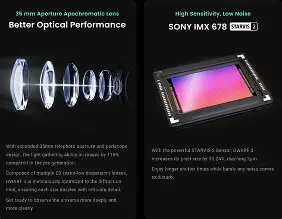
See Deals →The dual-lens system is the Dwarf III's secret weapon. Having a wide-angle lens to help you frame the general area and a telephoto lens for the actual capture is brilliant. I used the wide-angle camera more than I thought I would, specifically for capturing "context" shots of the Milky Way while the main lens was busy grinding away on a specific star cluster. This dual-stream capability is something I haven't seen executed this well in other competitors in this price bracket.
Daytime Use: More Than Just a Star Gazer
I’ve taken the Dwarf III on several hiking trips specifically to test its birding and wildlife capabilities. What I found was that the object tracking is spookily good for slow-moving subjects. I tracked a Great Blue Heron across a marsh, and the autofocus—while occasionally hunting in low light—maintained a sharp lock on the bird's eye. However, because the interface is entirely app-based, it lacks the tactile immediacy of a traditional DSLR. You aren't going to be capturing birds in flight with this; the lag between the sensor and your phone screen is just a few milliseconds too long for high-speed action. For stationary or slow-moving wildlife, though, it’s like having a high-end spotting scope that also records 4K video.
Specific Disappointments: The Honest Truth
It wouldn't be an honest review if I didn't mention the frustrations. One thing that bothered me was the internal storage management. There is no SD card slot; you are reliant on the internal memory. While it's reasonably large, if you're shooting 4K video or thousands of FITS files for deep-sky processing, you’ll find yourself needing to dump files to a laptop every few days. I also found the tripod that comes in the box to be a little too lightweight for my liking. In even a moderate breeze, the Dwarf III would vibrate enough to ruin a long-exposure stack. I eventually switched to a sturdier carbon fiber travel tripod, which significantly improved my "keeper" rate for images.
Another observation: the app interface can feel cluttered. There are so many sub-menus for things like gain, exposure time, and IR-cut filters that I occasionally tapped the wrong thing and ruined a sequence. I wish there was a "Pro Mode" and a "Simple Mode" that were more clearly delineated. I also noticed that the device gets quite warm during long imaging sessions. It never overheated to the point of shutting down, but the heat can introduce "thermal noise" into the images. I found that taking a 10-minute break between hour-long stacks helped keep the image quality consistent.
Pros & Cons
- Pros:
- Exceptional portability; literally fits in a large jacket pocket or small sling bag.
- The dual-camera system makes finding and framing targets incredibly intuitive.
- Internal filter wheel (including UHC and Solar filters) is a game-changer for convenience.
- Modern sensor provides impressive signal-to-noise ratio for such a small device.
- Software updates have been frequent, adding new features and fixing bugs based on user feedback.
- Fast setup time allows for "spontaneous" astronomy on weeknights.
- Cons:
- Battery life is mediocre in cold weather; requires an external power bank for long sessions.
- Built-in storage means you can't just swap cards; you must manually manage and delete files.
- The included mini-tripod is too light for windy conditions or high-precision tracking.
- App-based controls mean you are tethered to your phone; no physical buttons for quick adjustments.
- Field rotation is an inherent limitation for very long exposures of deep-sky targets.
- Internal sharpening for planetary/lunar shots can be over-processed in the JPEGs.
Comparing the Dwarf III to Traditional and Smart Alternatives
In my experience, the Dwarf III sits in a unique "middle ground." To help clarify where it stands, I've put together this comparison based on my testing against other gear I've owned or used extensively.
| Feature | Dwarf III | Entry-Level DSLR + Lens | Traditional Refractor + GoTo Mount |
|---|---|---|---|
| Setup Time | 2–5 Minutes | 5–10 Minutes | 30–45 Minutes |
| Portability | Excellent (Pocketable) | Moderate (Camera Bag) | Poor (Multiple Cases) |
| Ease of Use | High (App-driven) | Moderate (Manual) | Low (Steep Curve) |
| Image Quality | Good (Stacked) | Very Good | Excellent |
| Versatility | Astro + Terrestrial | General Purpose | Astro Only |
| Price to Value | High (All-in-one) | Variable | Low (High Entry Cost) |
Buying Guide: Is the Dwarf III Right for You?
After months of testing, I've realized that the Dwarf III isn't for everyone, despite the marketing. If you are an experienced astrophotographer with a dedicated cooled camera and a mono-filter wheel, the Dwarf III will feel like a toy to you. It lacks the raw resolution and the light-gathering power of a 100mm+ triplet refractor. You will find the edges of the frames soft and the lack of manual focus rings frustrating.
Find top-rated Cameras & Photography products at great prices.
Browse Now →However, if you fall into one of the following categories, I think you’ll find the hype to be justified. First, the "City Dweller." If you only have a small balcony or a 5-minute walk to a local park, the Dwarf III is the only telescope you will actually use. Its ability to punch through light pollution with the built-in filters and its tiny footprint make it the king of urban astronomy. Second, the "Casual Explorer." If you want to see the wonders of the night sky but have no interest in learning how to do a "drift align" or what "back-focus" means, this is the perfect gateway drug. And finally, the "Hybrid Hobbyist." If you hike, camp, and watch birds during the day but want to see the rings of Saturn at night, the versatility here is unmatched by anything else on the market.
When you go to use it, my biggest piece of advice is to invest in a better tripod immediately. You don't need a massive studio tripod, but something with a little weight and a hook for a sandbag will double your success rate. Also, don't be afraid to poke around in the settings. The default "Auto" mode is okay, but I found much better results by manually setting my gain to about 60–80 and my exposure to 10 or 15 seconds depending on how dark my skies were. And for the love of the stars, remember to take your "Darks." The Dwarf III has a routine for this, and it significantly reduces those annoying hot pixels and "walking noise" in your final stacks.
The Final Verdict
So, is the hype justified? I would say yes, but with an asterisk. The hype suggests a magic box that takes Hubble-quality photos with zero effort. The reality is a highly sophisticated, ultra-portable computer that takes great photos if you respect its limitations. I’ve been using this for months now, and while I still have my "big" gear for those rare nights when I have four hours to set up, the Dwarf III is what I grab 80% of the time. It has lowered the bar for entry into a notoriously difficult hobby, and it has done so without feeling like a cheap gimmick.
What I found was that the Dwarf III isn't just a camera; it's an invitation to look up more often. Because it's so easy to deploy, I find myself catching the Orion Nebula on a Tuesday night before bed, something I would never have done with my larger rigs. I noticed that I’ve learned more about the constellations and the movement of the planets in the last four months than I did in the two years prior, simply because I’m observing more frequently. It is a flawed, beautiful, and incredibly fun piece of technology that manages to pack an immense amount of power into a chassis the size of a thick novel. If you understand that you are buying into a system that prioritizes "fun" and "efficiency" over "absolute image perfection," then the Dwarf III is a purchase you won't regret. It’s the first smart telescope that I feel comfortable recommending to friends without appending a list of "how-to" manuals. It just works, and in the world of astronomy, that is perhaps the highest praise I can give.